
Best in: Spring, Summer, Fall, Winter
Ingredients (scaled)
8 servings
Directions
For the Crust: In a medium bowl, lightly mix the flour, sugar and salt. Add the cubes of butter, and using both hands, incorporate them into the flour by flattening the butter cubes between your fingertips and thumbs. Don't rub back and forth: try to flatten the two together in one direction. Use as light a touch as you can, as over-handling will make the dough tough and oily. You should end up with a rough, sandlike texture with some larger pea-sized pieces or flakes of flour-coated butter. It's not necessary to achieve a wholly uniform crumb, as a few larger pieces of butter help create flakiness.
Drop the vanilla and almond extracts into the water, and drizzle the liquid evenly over the flour/butter mixture. Using a fork or two blunt knives, lightly stir the dough until the crumbs just stick together when pinched. If you feel you need a little more water, add it very gradually, just a few drops at a time. The dough should not be wet, as this could make it heavy; but neither should it crumble. Before you gather it into a ball, give the dough one or two gentle 'kneads' on a work surface: gently flatten the loose dough in one direction using the heel of your hand. This will help lengthen the pockets of butter to create flakiness. Do this flattening action just once or twice, however, as over-kneading will develop the gluten in the flour and make the dough tough and liable to shrinkage.
Working with a light hand, gather the dough into a shallow disk ready for rolling, and wrap in cling film. Refrigerate for at least an hour. You can make it the day ahead, or freeze it and thaw while still wrapped. Let it soften slightly before rolling if you chill it longer than one hour.
To prepare the tart shell: Roll the rested pastry between two sheets of cling film, or on a lightly floured pastry board, into a circle a little under 11 inches in diameter (about 2 inches larger in diameter than your pastry tin - check the pan against it to judge). Aim for a thickness of about 6mm ( 1/4 inch) thick. Avoid making the centre thicker than the sides, and dont use more flour than you must.
Lightly butter the tart tin and wipe off the excess. Line the tin with the rolled pastry, and press it gently into the sides with your fingers, leaving the excess to hang over the edges for now. Trim off any unwieldy excess and save the scraps in case you need to do any repairs after pre-baking. Dock the base of the pastry a few times with a fork to create steam holes and cover the lined tin lightly with cling film and refrigerate for 1 hour so the pastry can rest. This is important, as otherwise the pastry will shrink away from the sides of the tin and could collapse. You can do this step several hours ahead, or freeze the shell, ready-to-bake.
Heat the oven to 375F when ready to pre-cook the pastry shell.
Lightly butter a sheet of baking parchment large enough to fit inside the tart shell, scrunch it up, and then unfold it and place the buttered side against the pastry to act as a liner. Tuck it gently into the sides and edges, and fill with baking weights to keep the bottom of the pastry flat when baking. Buttering the paper will help it to come off cleanly without damaging the fragile pastry underneath.
Bake for an initial 10-12 minutes or until set in the centre, and slightly golden on the edges, turning once in the oven for even cooking. Remove from the oven and carefully take out the parchment lining and the baking weights. If it looks set, proceed. If its still very undercooked, give it 5 minutes longer with the weights. Assuming it is set, protect your hands against the hot tart tin and carefully trim off the overhanging crust. Do this by running a sharp knife nearly flat along the edge, so the remaining crust is level with the top of the tart tin. Also take this opportunity to make any repairs as needed with the reserved raw dough. Its important to plug any holes or reinforce any areas where the tin is showing through, to avoid leakage.
Return the naked shell to the oven and bake for another 5 minutes or so, or until the pastry goes a shade darker all over. It should not be brown at this stage, but it should be set and have a slight golden colour, especially on the base. Remove the shell from the oven, still in its tin, and check again whether any repairs are needed; if so, make them while the shell is still warm as the raw dough will stick better. Put the tart on a rack to cool while you make the almond and cream filling - or pause here and store the completely cooled pastry shell in an airtight container for one or two days until ready to proceed.
To cook the filling and finish baking the tart: Heat the oven to 375F.
In a large heavy saucepan over low heat, use a spoon or silicon spatula to blend together the cream, sugar, salt, liqueurs, almond extract - everything but the almonds. Cook, stirring occasionally, until the sugar has dissolved completely and the mixture is silky smooth, about 10 minutes. Dont let it boil until the sugar has completely dissolved. Once the sugar has dissolved, bring the cream to a boil, stirring constantly, and let it boil vigorously until the bubbles get thicker, about 5 minutes. The mixture will still be quite thin and not much darker in colour, but thick enough to coat the back of a spoon and leave a clean run where you swipe it with a finger (take care, as its hot). When the mixture reaches this stage, take the pan off the heat and gently mix in the almonds until they are all well covered. Set aside for about 15 minutes for the almonds to absorb the flavours, and for the mixture to cool slightly.
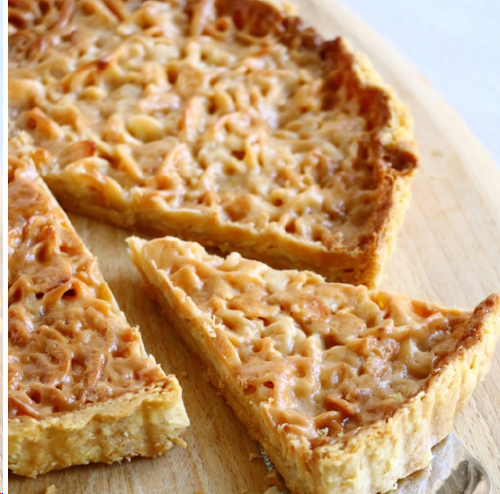
Pour the almond and cream mixture into the cooled pastry shell, and distribute the almonds evenly. Line the oven floor with some foil in case of overflow, and place the tart on the centre of the rack for about 30 minutes or until it has browned to an even and pleasant caramel colour. Rotate it in the oven two or three times in the last 15 minutes to facilitate this, watching carefully. The filling will boil up and then settle again and begin to caramelise. It will continue to boil away for a minute or two once you remove it from the oven, so take this into account and dont let it get too brown in the oven.
Remove the finished tart to a rack and cool completely - or if you have had some spillage, remove it from the outer ring while just warm, before the caramel sets hard. To remove it from the tin, carefully use the tip of a sharp knife to prise it away in any places where the caramel has made contact with the tin. Its sometimes helpful to place the tart on top of a tin of beans or similar, and push gently downwards to remove the ring. To remove it from the metal base, find a place along the bottom of the tart crust where you can get some purchase and carefully run a long spatula or knife underneath the entire tart to loosen it. Then set it level with your serving plate and slide the tart onto it without lifting any more than necessary.
Drop the vanilla and almond extracts into the water, and drizzle the liquid evenly over the flour/butter mixture. Using a fork or two blunt knives, lightly stir the dough until the crumbs just stick together when pinched. If you feel you need a little more water, add it very gradually, just a few drops at a time. The dough should not be wet, as this could make it heavy; but neither should it crumble. Before you gather it into a ball, give the dough one or two gentle 'kneads' on a work surface: gently flatten the loose dough in one direction using the heel of your hand. This will help lengthen the pockets of butter to create flakiness. Do this flattening action just once or twice, however, as over-kneading will develop the gluten in the flour and make the dough tough and liable to shrinkage.
Working with a light hand, gather the dough into a shallow disk ready for rolling, and wrap in cling film. Refrigerate for at least an hour. You can make it the day ahead, or freeze it and thaw while still wrapped. Let it soften slightly before rolling if you chill it longer than one hour.
To prepare the tart shell: Roll the rested pastry between two sheets of cling film, or on a lightly floured pastry board, into a circle a little under 11 inches in diameter (about 2 inches larger in diameter than your pastry tin - check the pan against it to judge). Aim for a thickness of about 6mm ( 1/4 inch) thick. Avoid making the centre thicker than the sides, and dont use more flour than you must.
Lightly butter the tart tin and wipe off the excess. Line the tin with the rolled pastry, and press it gently into the sides with your fingers, leaving the excess to hang over the edges for now. Trim off any unwieldy excess and save the scraps in case you need to do any repairs after pre-baking. Dock the base of the pastry a few times with a fork to create steam holes and cover the lined tin lightly with cling film and refrigerate for 1 hour so the pastry can rest. This is important, as otherwise the pastry will shrink away from the sides of the tin and could collapse. You can do this step several hours ahead, or freeze the shell, ready-to-bake.
Heat the oven to 375F when ready to pre-cook the pastry shell.
Lightly butter a sheet of baking parchment large enough to fit inside the tart shell, scrunch it up, and then unfold it and place the buttered side against the pastry to act as a liner. Tuck it gently into the sides and edges, and fill with baking weights to keep the bottom of the pastry flat when baking. Buttering the paper will help it to come off cleanly without damaging the fragile pastry underneath.
Bake for an initial 10-12 minutes or until set in the centre, and slightly golden on the edges, turning once in the oven for even cooking. Remove from the oven and carefully take out the parchment lining and the baking weights. If it looks set, proceed. If its still very undercooked, give it 5 minutes longer with the weights. Assuming it is set, protect your hands against the hot tart tin and carefully trim off the overhanging crust. Do this by running a sharp knife nearly flat along the edge, so the remaining crust is level with the top of the tart tin. Also take this opportunity to make any repairs as needed with the reserved raw dough. Its important to plug any holes or reinforce any areas where the tin is showing through, to avoid leakage.
Return the naked shell to the oven and bake for another 5 minutes or so, or until the pastry goes a shade darker all over. It should not be brown at this stage, but it should be set and have a slight golden colour, especially on the base. Remove the shell from the oven, still in its tin, and check again whether any repairs are needed; if so, make them while the shell is still warm as the raw dough will stick better. Put the tart on a rack to cool while you make the almond and cream filling - or pause here and store the completely cooled pastry shell in an airtight container for one or two days until ready to proceed.
To cook the filling and finish baking the tart: Heat the oven to 375F.
In a large heavy saucepan over low heat, use a spoon or silicon spatula to blend together the cream, sugar, salt, liqueurs, almond extract - everything but the almonds. Cook, stirring occasionally, until the sugar has dissolved completely and the mixture is silky smooth, about 10 minutes. Dont let it boil until the sugar has completely dissolved. Once the sugar has dissolved, bring the cream to a boil, stirring constantly, and let it boil vigorously until the bubbles get thicker, about 5 minutes. The mixture will still be quite thin and not much darker in colour, but thick enough to coat the back of a spoon and leave a clean run where you swipe it with a finger (take care, as its hot). When the mixture reaches this stage, take the pan off the heat and gently mix in the almonds until they are all well covered. Set aside for about 15 minutes for the almonds to absorb the flavours, and for the mixture to cool slightly.
Pour the almond and cream mixture into the cooled pastry shell, and distribute the almonds evenly. Line the oven floor with some foil in case of overflow, and place the tart on the centre of the rack for about 30 minutes or until it has browned to an even and pleasant caramel colour. Rotate it in the oven two or three times in the last 15 minutes to facilitate this, watching carefully. The filling will boil up and then settle again and begin to caramelise. It will continue to boil away for a minute or two once you remove it from the oven, so take this into account and dont let it get too brown in the oven.
Remove the finished tart to a rack and cool completely - or if you have had some spillage, remove it from the outer ring while just warm, before the caramel sets hard. To remove it from the tin, carefully use the tip of a sharp knife to prise it away in any places where the caramel has made contact with the tin. Its sometimes helpful to place the tart on top of a tin of beans or similar, and push gently downwards to remove the ring. To remove it from the metal base, find a place along the bottom of the tart crust where you can get some purchase and carefully run a long spatula or knife underneath the entire tart to loosen it. Then set it level with your serving plate and slide the tart onto it without lifting any more than necessary.
Notes
Click to add notes...
Nutrition Facts (per serving)
Calories
g
Protein
g
Carbs
g
Fat
g
Fiber
g
Sugar
mg
Sodium
mg
Cholesterol