
Best in: Spring, Summer, Fall, Winter
Ingredients (scaled)
21 servings
Directions
Lightly oil a 2-3 litre square plastic container. It's important to use a square tub here to help shape the dough. Tip the flour in the bowl of the mixer and add the salt to one side and the yeast to the other side, so they're not close. Add ?¾ of the water and begin mixing on a slow speed. As the dough starts to come together, slowly add the remaining water. Then mix for a further 5-8 minutes on a medium speed until the dough is smooth and stretchy.
Tip the dough into the prepared tub and spread it so it reaches all sides and corners. Cover with cling film and put in a very low oven (the most effective and quickest way to prove, I find). Leave it there until it has doubled or trebled in size.
When it has done so, remove and turn the oven temperature up to 220C. Line two baking trays with baking parchment or silicone paper. If using baking paper, dust with lots of the strong flour.
Dust your work surface heavily with more of the flour and add some semolina too, if you have it. Carefully tip out the dough (its pretty wet) onto the work surface. There is no need for knocking back, in fact try not to handle it much at all. You want to keep as much air in the dough as possible.
Coat the top of the dough with more flour and/or semolina. Cut the dough in half length ways and divide each of those in half length ways also. You should now have four long pieces of dough. Stretch each piece a bit length ways and place on the prepared baking trays.
Tip | Its a bit tricky transferring these long pieces of dough onto the trays, because theyre so floppy and sticky. I used two long knives and slid them under each end, trying to lift them like that. That worked for the first couple, but not for the last two. I managed to use one knife and my hand in the end, rolling part of one end onto my hand and lifting the other with the knife. Either way, youll get them on the trays in the end.
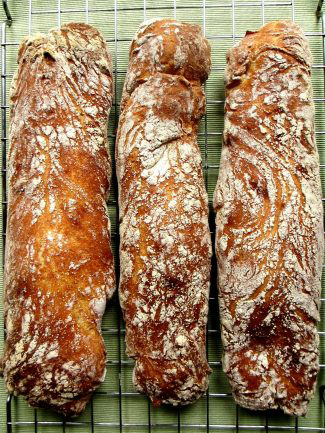
Leave the dough to rest for 10 minutes, then bake for 25 minutes or until the loaves are golden brown and sound hollow when tapped. Cool on a wire rack - try and eat some warm though. Not difficult.
Tip the dough into the prepared tub and spread it so it reaches all sides and corners. Cover with cling film and put in a very low oven (the most effective and quickest way to prove, I find). Leave it there until it has doubled or trebled in size.
When it has done so, remove and turn the oven temperature up to 220C. Line two baking trays with baking parchment or silicone paper. If using baking paper, dust with lots of the strong flour.
Dust your work surface heavily with more of the flour and add some semolina too, if you have it. Carefully tip out the dough (its pretty wet) onto the work surface. There is no need for knocking back, in fact try not to handle it much at all. You want to keep as much air in the dough as possible.
Coat the top of the dough with more flour and/or semolina. Cut the dough in half length ways and divide each of those in half length ways also. You should now have four long pieces of dough. Stretch each piece a bit length ways and place on the prepared baking trays.
Tip | Its a bit tricky transferring these long pieces of dough onto the trays, because theyre so floppy and sticky. I used two long knives and slid them under each end, trying to lift them like that. That worked for the first couple, but not for the last two. I managed to use one knife and my hand in the end, rolling part of one end onto my hand and lifting the other with the knife. Either way, youll get them on the trays in the end.
Leave the dough to rest for 10 minutes, then bake for 25 minutes or until the loaves are golden brown and sound hollow when tapped. Cool on a wire rack - try and eat some warm though. Not difficult.
Notes
Click to add notes...
Nutrition Facts (per serving)
Calories
g
Protein
g
Carbs
g
Fat
g
Fiber
g
Sugar
mg
Sodium
mg
Cholesterol