
Ingredients (scaled)
6 servings
Directions
My mother made terrific custard. Baked in brown ceramic cups with white glazed interiors the top sprinkled with nutmeg, it was heavenly. I ate her custard, hot or cold, straight out of the cup. But it wasnt until I was 16 years old while on a trip to Santa Fe, New Mexico, that I realized there was more to custard than moms humble pudding.
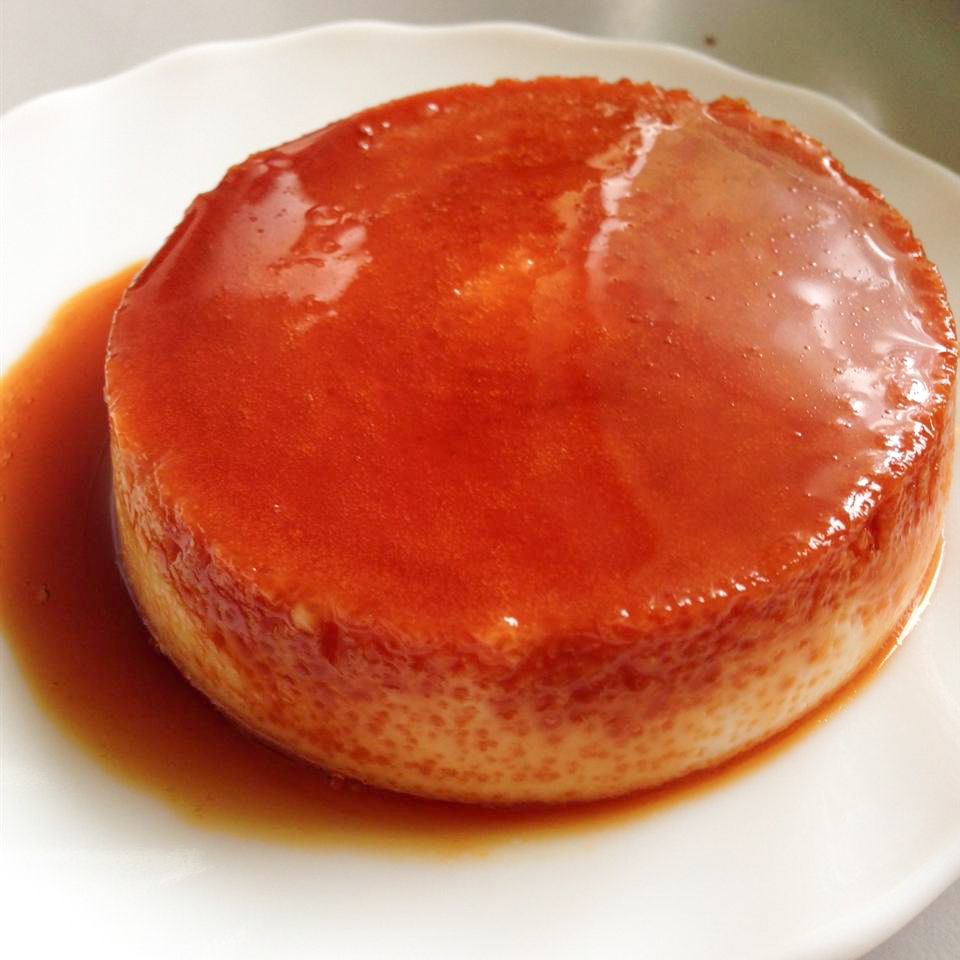
It was there, at the historic La Fonda Hotel, that I first tasted Flan. The menu described flan as baked custard, but this flan wasnt like anything mom had ever made. Instead of in a cup, it was served on a plate, where it sat quivering un a pool of dark caramel sauce. That first bite slid across my tongue, and I was thrilled by the contrast between the rich eggy custard and the slightly burnt taste of caramel. I had no idea how flan was made, but I promised myself then that Id learn. In the years since that night at La Fonda, Ive made hundreds, probably even thousands of caramel custards, both at home and in restaurant kitchens. In that time Ive learned that flan is simply the Spanish cousin of the French-born creme caramel, but made with sweetened condensed milk rather than whole milk or cream. At heart they are the same, an egg-rich custard baked in a caramel-lined cup, unmolded and served un its own sweet sauce. In its most basic form, custard is a mixture of a milk product (whole milk, half-and-half, cream, condensed milk, or skim milk), sugar, eggs (with additional yolks sometimes added), and flavorings. Alter the type of milk and the quantity of eggs and egg yolk, and you can change the texture and flavor of the finished custard. It should be no secret that fat is the key to a creamy custard. However, the richest custards, made primarily of cream and egg yolks, are too soft to unmold. Without the proteins particular to egg whites, a custard wont set properly. Baked cream- and-egg-yolk custards remain practically liquid and must be served in their baking molds. Theyre perfect for creme brulee, with a crisp layer of caramel on top. Custards made with sweetened condensed milk (like my first flan) are part of the cuisines of Central America and Southeast Asia. Condensed-milk custards are sweet and have a rich texture similar to those made with heavy cream. At the other end of the scale, custards made with skim milk and few egg yolks set up and unmold very easy. The texture is as smooth as any custard made with whole milk and whole eggs, but they dont taste as rich. In my opinion the best creme caramel is made with whole milk and whole eggs with a few extra yolks added for richness. The texture is silky smooth and deliciously rich.
MAKE THE CARAMEL WITH CAUTION Use a heavy, 1- to 1-1/2-quart saucepan with a flat bottom and a snug-fitting lid to cook the caramel. The characteristics of the pan and lid are important. A level bottom helps the sugar cook evenly, and a heavy pan is less likely to have hot spots, which could allow the sugar to burn Be sure the lid is tight enough to capture the steam You want the steam to condense and wash away any sugar crystals that might cling to the sides of the pan. Before you start caramelizing the sugar, arrange your molds so theyre close at hand. Combine the water and sugar (see recipe below) in a separate mixing bowl, stirring until the sugar is almost dis solved, then pour the mixture directly into the center of the saucepan. This may seem like an un necessary step, but it will help you avoid getting sugar crystals on the sides of the pan, where they may not dissolve. A single undissolved sugar crystal can start a chain reaction, promoting the formation of others until the entire caramel mixture becomes grainy. Bring the sugar water to a boil and, as an extra precaution, dip a small (1- to 1-1/2 inch) pastry brush in cold water and brush around the inside of the pan. Cover the pan and boil 1 minute to make sure no sugar crystals remain. Do not stir. Uncover and continue boiling until the sugar begins to color. Gently swirl the pan over the heat until the caramel is medium-dark brown. A light colored caramel hasnt enough flavor, and a really dark caramel tastes burned. Once the sugar starts caramelizing, watch it closely so that you can stop it at the just the right moment. Sugar starts to color at 310 F; at 338 F it starts to burn; and it will be completely black at 350. The total cooking time is about 10 to 15 minutes. Pay attention: its hot and sets quickly. Dont let yourself get distracted when making caramel. Hot sugar can cause serious burns. Once the color is right, quickly pour the caramel into the molds, dividing it as evenly as possible. Ceramic molds can be individual size, or large enough for an entire recipe of custard. I prefer flat-bottom molds with straight sides. They produce a good looking creme caramel, and they unmold more easily than molds with smaller bottoms and sloping sides. As you pour the caramel into the molds, youll notice that the caramel in the last mold filled will be darker than that in the first. Thats because the sugar continues to cook from the residual heat in the pan. You want to work quickly, so the caramel wont overcook before you get it into the molds. Once youve poured all the caramel, pick up each mold and tilt it so that the caramel covers the bottom evenly and starts to run up the sides. Use a hot pad or towel to hold the molds-they will be hot. If the caramel is too light or too dark, soak the molds to remove the caramel and make a new batch. You havent lost anything at this point, and the experience will help you find the right color.
STIR GENTLY, BAKE GENTLY To make the custard, heat the milk until it just barely simmers; boiling milk can curdle the eggs. While the milk is heating, gently combine the eggs, sugar, vanilla extract, and salt in a bowl. Use a small spoon (not a whisk) to mix the eggs. You want just to combine the ingredients without beating in any air that can leave bubbles in your custard. Slowly pour the heated milk into the egg mixture without splashing, stirring gently all the while. Pour the custard through a fine sieve into the caramel-lined molds, filling to just below the rim. The sieve will remove any undissolved sugar and egg particles and ensure the smoothest possible custard. Let the custard base sit in the molds undisturbed for about five minutes to allow any bubbles to collapse. With the tip of a small knife, gently deflate any remaining bubbles clinging to the edge of the molds. Heat the oven to 300 F. Cooking the egg-rich custards at a relatively low temperature helps prevent curdling. Set the filled molds in a flat, shallow pan, not more than 1/2 to 1 inch deeper than your molds, to use as a water bath. Pour hot tap water into the pan until it reaches 1/2 to 3/4 of the way up the sides of the molds. Cover the pan with aluminum foil to keep the tops of the custards from forming a skin, but take care that the foil doesnt actually touch the custards. Cooking time depends on the size and thickness of the molds. Large molds need more time than small ones, and thick-walled molds take longer than thin ones. Delicate 1/2-cup molds cook in 25 to 30 minutes; thick walled 1/2-cup molds need 40 to 50 minutes. Experience will teach you how long it takes to bake custards in your particular molds, and in your oven. Be careful not to overcook your custards. Once their soft texture has been ruined, theres no way to get it back. Slow cooking and cooling gives you the best chance of achieving quiveringly perfect creme caramel. Testing for texture. To test for doneness, slip a paring knife into the custard halfway between the edge of the mold and the center. If the knife comes out clean, the custard is ready to come out of the oven. The center should still be slightly liquid. Remove the water bath from the oven and loosen the foil to vent the steam, but keep the custards covered. Leave them in the water bath to cool at room temperature. The custards will finish cooking as they cool. If your knife comes out completely clean from the center of the mold (rather than halfway between the center and the edge) and the custard seems fairly solid, then the custard is already fully cooked and should be cooled quickly on a rack. Air cooling is faster than cooling in the water bath and will minimize further cooking. Overcooked custards begin to puff after they set and will form a skin even if covered. When the custards reach room temperature, cover them tightly with plastic wrap (again to prevent a skin from forming) and refrigerate them for at least 24 hours. This resting period allows the custards to set completely and for the caramel to melt, making unmolding easier.
Just before serving, remove the molds from the refrigerator. Carefully run your thinnest paring knife around the edge of the mold to loosen the custard. Keep the knife blade flat against the side of the mold. Cutting into the custard will result in ragged edges and leave pieces of custard floating in the sauce. Tap the mold with the heel of your hand to finish loosening the custard. If you see caramel sauce between the custard and the side of the mold, you know your custard is loose. Invert a serving plate on top of the mold, and turn the whole thing upside down. The custard should release itself. If suction prevents the custard from releasing, gently tap on the bottom of the mold or gently hit the heel of your hand against the side of the mold. Be sure to let all the melted caramel drizzle from the mold over the custard. Look closely at the texture of the custard and take mental notes for fine-tuning your technique. The custard should be perfectly smooth with very few air bubbles. Gently hit the heel of your hand against the serving plate. The custard should quiver - the sign of a silky, smooth texture. A custard thats underdone will bread in the unmolding or wont hold its shape on the plate. An overdone custard will barely wiggle, even when the plate is hit hard. To develop your technique, make creme caramel and its variations your specialty for several months. Each batch will teach you something new about the amazing egg and its ability to turn sugar and milk and a bit of flavoring for a truly perfect dessert.
Variations on Creme Caramel Make coffee-flavored creme caramel, like the one pictured below, by dissolving instant espresso in the milk. To make citrus or ginger-flavored custard, heat the milk to just below a simmer, add the flavoring, ant remove from the heat. Cover the pot ant let the milk steep for about 30 minutes. Gently reheat the milk to a slow simmer before combining it with the eggs and sugar. CITRUS Zest of 1 large orange and zest of 2 lemons. Reduce vanilla extract to 1/2 tsp. GINGER 2 Tbs. grated fresh ginger. Reduce vanilla extract to 1/2 tsp. COFFEE 2 Tbs. instant espresso granules. Reduce vanilla extract to 1 tsp. Add 2 Tbs. coffee flavored liqueur (I prefer Tia Maria) to the egg sugar mixture. CREME CARAMEL CARAMEL: 1/2 cup water 3/4 cup sugar
It was there, at the historic La Fonda Hotel, that I first tasted Flan. The menu described flan as baked custard, but this flan wasnt like anything mom had ever made. Instead of in a cup, it was served on a plate, where it sat quivering un a pool of dark caramel sauce. That first bite slid across my tongue, and I was thrilled by the contrast between the rich eggy custard and the slightly burnt taste of caramel. I had no idea how flan was made, but I promised myself then that Id learn. In the years since that night at La Fonda, Ive made hundreds, probably even thousands of caramel custards, both at home and in restaurant kitchens. In that time Ive learned that flan is simply the Spanish cousin of the French-born creme caramel, but made with sweetened condensed milk rather than whole milk or cream. At heart they are the same, an egg-rich custard baked in a caramel-lined cup, unmolded and served un its own sweet sauce. In its most basic form, custard is a mixture of a milk product (whole milk, half-and-half, cream, condensed milk, or skim milk), sugar, eggs (with additional yolks sometimes added), and flavorings. Alter the type of milk and the quantity of eggs and egg yolk, and you can change the texture and flavor of the finished custard. It should be no secret that fat is the key to a creamy custard. However, the richest custards, made primarily of cream and egg yolks, are too soft to unmold. Without the proteins particular to egg whites, a custard wont set properly. Baked cream- and-egg-yolk custards remain practically liquid and must be served in their baking molds. Theyre perfect for creme brulee, with a crisp layer of caramel on top. Custards made with sweetened condensed milk (like my first flan) are part of the cuisines of Central America and Southeast Asia. Condensed-milk custards are sweet and have a rich texture similar to those made with heavy cream. At the other end of the scale, custards made with skim milk and few egg yolks set up and unmold very easy. The texture is as smooth as any custard made with whole milk and whole eggs, but they dont taste as rich. In my opinion the best creme caramel is made with whole milk and whole eggs with a few extra yolks added for richness. The texture is silky smooth and deliciously rich.
MAKE THE CARAMEL WITH CAUTION Use a heavy, 1- to 1-1/2-quart saucepan with a flat bottom and a snug-fitting lid to cook the caramel. The characteristics of the pan and lid are important. A level bottom helps the sugar cook evenly, and a heavy pan is less likely to have hot spots, which could allow the sugar to burn Be sure the lid is tight enough to capture the steam You want the steam to condense and wash away any sugar crystals that might cling to the sides of the pan. Before you start caramelizing the sugar, arrange your molds so theyre close at hand. Combine the water and sugar (see recipe below) in a separate mixing bowl, stirring until the sugar is almost dis solved, then pour the mixture directly into the center of the saucepan. This may seem like an un necessary step, but it will help you avoid getting sugar crystals on the sides of the pan, where they may not dissolve. A single undissolved sugar crystal can start a chain reaction, promoting the formation of others until the entire caramel mixture becomes grainy. Bring the sugar water to a boil and, as an extra precaution, dip a small (1- to 1-1/2 inch) pastry brush in cold water and brush around the inside of the pan. Cover the pan and boil 1 minute to make sure no sugar crystals remain. Do not stir. Uncover and continue boiling until the sugar begins to color. Gently swirl the pan over the heat until the caramel is medium-dark brown. A light colored caramel hasnt enough flavor, and a really dark caramel tastes burned. Once the sugar starts caramelizing, watch it closely so that you can stop it at the just the right moment. Sugar starts to color at 310 F; at 338 F it starts to burn; and it will be completely black at 350. The total cooking time is about 10 to 15 minutes. Pay attention: its hot and sets quickly. Dont let yourself get distracted when making caramel. Hot sugar can cause serious burns. Once the color is right, quickly pour the caramel into the molds, dividing it as evenly as possible. Ceramic molds can be individual size, or large enough for an entire recipe of custard. I prefer flat-bottom molds with straight sides. They produce a good looking creme caramel, and they unmold more easily than molds with smaller bottoms and sloping sides. As you pour the caramel into the molds, youll notice that the caramel in the last mold filled will be darker than that in the first. Thats because the sugar continues to cook from the residual heat in the pan. You want to work quickly, so the caramel wont overcook before you get it into the molds. Once youve poured all the caramel, pick up each mold and tilt it so that the caramel covers the bottom evenly and starts to run up the sides. Use a hot pad or towel to hold the molds-they will be hot. If the caramel is too light or too dark, soak the molds to remove the caramel and make a new batch. You havent lost anything at this point, and the experience will help you find the right color.
STIR GENTLY, BAKE GENTLY To make the custard, heat the milk until it just barely simmers; boiling milk can curdle the eggs. While the milk is heating, gently combine the eggs, sugar, vanilla extract, and salt in a bowl. Use a small spoon (not a whisk) to mix the eggs. You want just to combine the ingredients without beating in any air that can leave bubbles in your custard. Slowly pour the heated milk into the egg mixture without splashing, stirring gently all the while. Pour the custard through a fine sieve into the caramel-lined molds, filling to just below the rim. The sieve will remove any undissolved sugar and egg particles and ensure the smoothest possible custard. Let the custard base sit in the molds undisturbed for about five minutes to allow any bubbles to collapse. With the tip of a small knife, gently deflate any remaining bubbles clinging to the edge of the molds. Heat the oven to 300 F. Cooking the egg-rich custards at a relatively low temperature helps prevent curdling. Set the filled molds in a flat, shallow pan, not more than 1/2 to 1 inch deeper than your molds, to use as a water bath. Pour hot tap water into the pan until it reaches 1/2 to 3/4 of the way up the sides of the molds. Cover the pan with aluminum foil to keep the tops of the custards from forming a skin, but take care that the foil doesnt actually touch the custards. Cooking time depends on the size and thickness of the molds. Large molds need more time than small ones, and thick-walled molds take longer than thin ones. Delicate 1/2-cup molds cook in 25 to 30 minutes; thick walled 1/2-cup molds need 40 to 50 minutes. Experience will teach you how long it takes to bake custards in your particular molds, and in your oven. Be careful not to overcook your custards. Once their soft texture has been ruined, theres no way to get it back. Slow cooking and cooling gives you the best chance of achieving quiveringly perfect creme caramel. Testing for texture. To test for doneness, slip a paring knife into the custard halfway between the edge of the mold and the center. If the knife comes out clean, the custard is ready to come out of the oven. The center should still be slightly liquid. Remove the water bath from the oven and loosen the foil to vent the steam, but keep the custards covered. Leave them in the water bath to cool at room temperature. The custards will finish cooking as they cool. If your knife comes out completely clean from the center of the mold (rather than halfway between the center and the edge) and the custard seems fairly solid, then the custard is already fully cooked and should be cooled quickly on a rack. Air cooling is faster than cooling in the water bath and will minimize further cooking. Overcooked custards begin to puff after they set and will form a skin even if covered. When the custards reach room temperature, cover them tightly with plastic wrap (again to prevent a skin from forming) and refrigerate them for at least 24 hours. This resting period allows the custards to set completely and for the caramel to melt, making unmolding easier.
Just before serving, remove the molds from the refrigerator. Carefully run your thinnest paring knife around the edge of the mold to loosen the custard. Keep the knife blade flat against the side of the mold. Cutting into the custard will result in ragged edges and leave pieces of custard floating in the sauce. Tap the mold with the heel of your hand to finish loosening the custard. If you see caramel sauce between the custard and the side of the mold, you know your custard is loose. Invert a serving plate on top of the mold, and turn the whole thing upside down. The custard should release itself. If suction prevents the custard from releasing, gently tap on the bottom of the mold or gently hit the heel of your hand against the side of the mold. Be sure to let all the melted caramel drizzle from the mold over the custard. Look closely at the texture of the custard and take mental notes for fine-tuning your technique. The custard should be perfectly smooth with very few air bubbles. Gently hit the heel of your hand against the serving plate. The custard should quiver - the sign of a silky, smooth texture. A custard thats underdone will bread in the unmolding or wont hold its shape on the plate. An overdone custard will barely wiggle, even when the plate is hit hard. To develop your technique, make creme caramel and its variations your specialty for several months. Each batch will teach you something new about the amazing egg and its ability to turn sugar and milk and a bit of flavoring for a truly perfect dessert.
Variations on Creme Caramel Make coffee-flavored creme caramel, like the one pictured below, by dissolving instant espresso in the milk. To make citrus or ginger-flavored custard, heat the milk to just below a simmer, add the flavoring, ant remove from the heat. Cover the pot ant let the milk steep for about 30 minutes. Gently reheat the milk to a slow simmer before combining it with the eggs and sugar. CITRUS Zest of 1 large orange and zest of 2 lemons. Reduce vanilla extract to 1/2 tsp. GINGER 2 Tbs. grated fresh ginger. Reduce vanilla extract to 1/2 tsp. COFFEE 2 Tbs. instant espresso granules. Reduce vanilla extract to 1 tsp. Add 2 Tbs. coffee flavored liqueur (I prefer Tia Maria) to the egg sugar mixture. CREME CARAMEL CARAMEL: 1/2 cup water 3/4 cup sugar
Notes
Click to add notes...
Nutrition Facts (per serving)
Calories
g
Protein
g
Carbs
g
Fat
g
Fiber
g
Sugar
mg
Sodium
mg
Cholesterol