
Best in: Spring, Summer, Fall
Fresh: berries, stone fruits, citrus
Ingredients (scaled)
1 servings
Directions
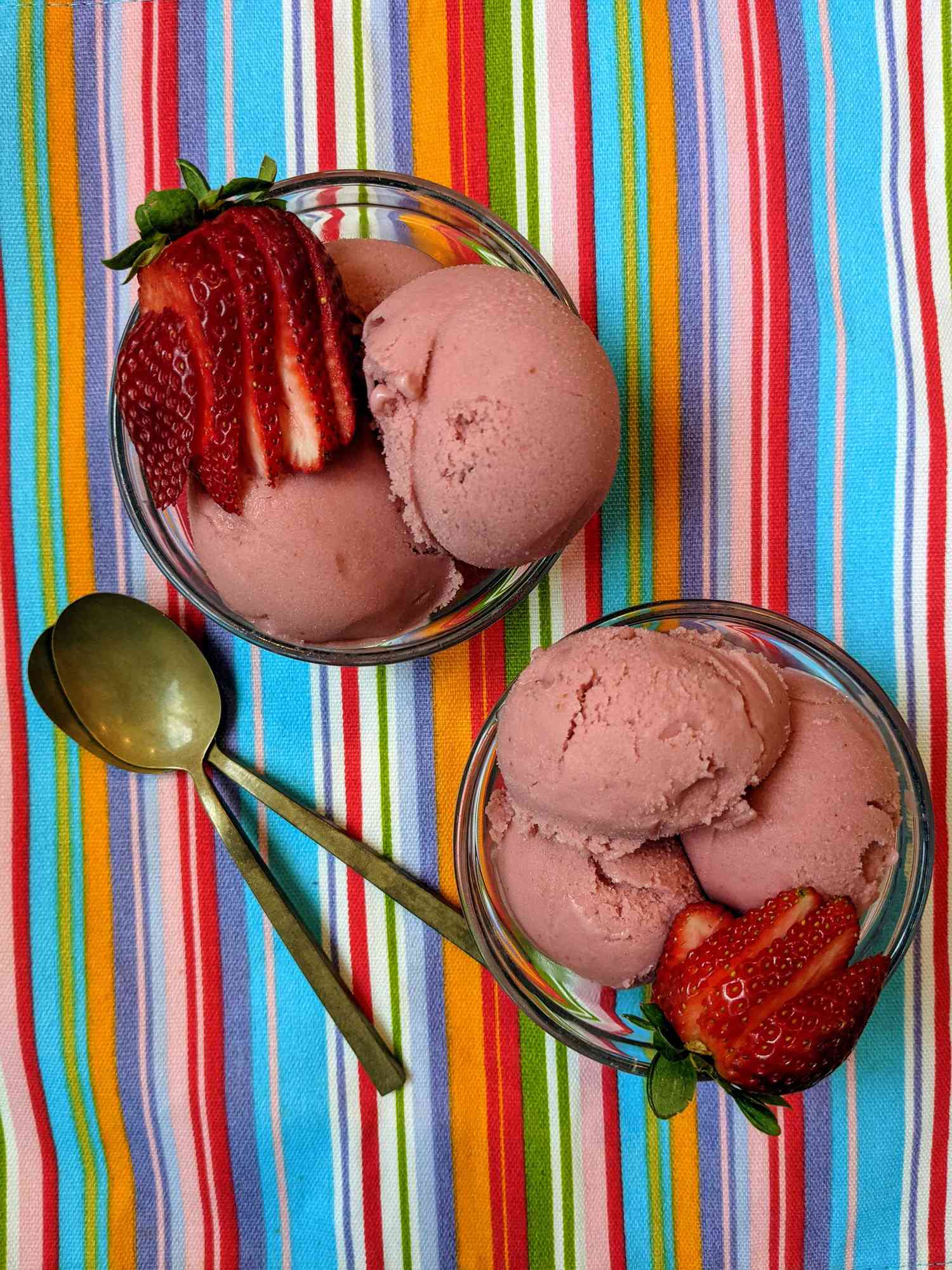
Some credit Florentine court architect Bernardo Buontalenti with making the first gelato. At his patron Grand Duke Ferdinand de Medicis wedding festivities on May 7, 1589, marvels of gelati were served at the conclusion of the banquet, before the after-dinner entertainment-an 18-vessel naval battle in a flooded courtyard. In the 17th Century it was discovered that if you churned sorbetto while it was freezing, it didnt freeze solid and became something you could eat with a spoon, rather than chewing it like an ice cube. It was exclusive to Italy until a Sicilian named Francesco Procopio deColtelli went to Paris in 1660 and opened Cafe Procope. He introduced Parisians to the confection that many think of under the French form of the name, sorbet. Technically, a gelato is an ice cream, made from a milk or custard-based mixture, while a sorbetto is a water-based ice. Fruit flavors are usually, but not always, water-based, and, therefore, should be called sorbetti, but theyre not. In practice, the term sorbetto is limited to ancient cookbooks and a small number of obsessive restaurants that make their own. Today, almost everyone uses the word gelato for both fruit and milk or custard-based flavors. It is at its very best when its made From fresh ingredients, according to one of three main Italian regional schools of philosophy. Veneto, in the north, is well supplied with milk and cream and includes one or both of these dairy products in almost all gelato. Sicilians are big on sugar, short on dairy products other than ricotta, masters of flavor and texture. They perform a last minute softening-up with a spatula before gelato is smeared onto a cone or soft, sweet brioche roll. Tuscany combines the best of both schools and comes up with water-based fruit flavors, less sweet than the Sicilians make them, and silky milk-based custard gelati. Prepared by small scale artisans and consumed right outside the shop, gelato is the perfect between meal refreshment and the core of an important warm-weather ritual. Most Italians live within walking distance of homemade gelato and frequently head for a local gelateria to cool off, take a break and possibly bump into friends. They may also order granita-a grainy ice-and Semifreddo made from gelato base with whipped cream folded in. I decided to try making my own. I first spoke to my favorite professional gelato makers in three regions. How much sugar? They all supplied the standard answer, right out of the manual (Il Gelato Artigianale Italiano by G. Preti): one-third. I tried this and rejected it (too sweet, although it remained scoopable). Pretis formulas also utilize stabilizers and powdered milk. I thought about using them, and rejected the idea. Why bother using ingredients intended to give gelato a longer freezer life when it is at its best within a few hours of preparation ? Continuing the search, I read Harold McGees The Curious Cook, got hooked on the idea of a formula, and made pages of calculations involving lists of fruit, natural sugar and final sugar percentage, which I preferred at around 27%, far below the ideal scoopable freezing percentage but above the minimum to produce a creamy non-granular gelato. I refused to buy a hydrometer to measure sugar content. I read Jeff Steingarten in Vogue on the ripeness of fruit and noticed in my heaviest Italian nutrition text that fruit sugar wasnt expressed as a weight but a ration of unripe to ripe (2% for peach, apricot and lemon, 4% for strawberry, melon and up to 11% for banana). This makes the idea of a formula impossible. The best advice about sugar came from Renson Grant, who makes gelato and sorbetto at Jumby Bay, a resort off the coast of Antigua: Sweeten to taste. His basic fruit formula was very similar to mine. Realmo Cavalleri, my favorite Tuscan maker of gelato from San Giorgio a Colonica, concurred with Grant, citing variable fruit sweetness and personal taste as important factors when adding sugar. Homemade gelato freak Cesare Bardini (producer of Agrimontana preserves, chestnuts and candied violets) told me not to bother with sugar syrup but to boil the water for gelato to avoid fruit discoloration. Chemistry, folklore or both? I boil the water, and my fruit no longer oxidizes. Wild and exotic fruits, too extravagant to be commercially viable, make the best gelato. Seasonal ripe soft fruit produces the finest product, but even lackluster fruit seems to pick up flavor in the freezing process. Unbelievably, berry, peach, melon and banana gelato taste better than the actual fruit. I use an Italian gelato machine with a built-in refrigeration unit. Standard hand-crank or electric ice cream machines work just fine. Five ingredients and no cooking (unless you count boiling water) probably make this the worlds easiest gelato recipe. Eat no-fat gelato (or sorbetto) fresh, just out of the machine, at its creamiest, or within a few hours of its creation, firm enough to scoop but before the freezer turns it to stone-it doesnt have enough sugar to stay soft. Leftovers should be partially thawed until scoopable. This is a basic recipe, meant to be modified (extra sugar can be added) for individual fruit sweetness, degree of ripeness and personal taste. Such high-sugar fruits as grape, banana, mango and kiwi will be fine with a minimal 1/2 cup of sugar. Taste, and if mixture doesnt seem sweet enough, add 1 tablespoon sugar at a time until desired sweetness is achieved. Blueberries, cherries, pineapple, papayas, figs, plums, tangerines and apricots have less sugar than the previous group of fruits and need an extra 1 or 2 tablespoons of sugar, one at a time, then tasted. Strawberry, blackberry, raspberry, peach, melon, orange and grapefruit have lower sugar contents and will need 2 tablespoons of extra sugar, possibly 3 tablespoons, depending on ripeness and flavor of fruit. dess 159c
Notes
Click to add notes...
Nutrition Facts (per serving)
Calories
g
Protein
g
Carbs
g
Fat
g
Fiber
g
Sugar
mg
Sodium
mg
Cholesterol