
Best in: Spring, Summer, Fall, Winter
Ingredients (scaled)
1 servings
Directions
Warm milk to 32°C in sterilized stainless steel covered pot . Meanwhile, dissolve rennet in 1/4 c water.
Blend yogurt and buttermilk together, add a small amount of milk, whisk into 32°C milk.
Stir in dissolved rennet thoroughly, cover, let sit in warm spot until gelled (clean break), about 45 minutes.
Cut curd with clean knife into 1/2 inch cubes. (See my protocol for basic cheese, steps 9 and 10 for precise instructions on cutting the curd).
Re-warm to 32°C with stirring, cutting larger chunks of curd into smaller pieces with table knife. Let sit 15 minutes.
Pour off whey (save for ricotta), add curd to 2 qts cold water to rinse, drain in colander.
CRITICAL STEP FOR PROPER SPINNING OF THE CURD: Let sit at room temperature to develop acidity. The last two times I have made it, I let it sit overnight, and it was ripe for spinning. The final pH should be 5.3. You can monitor the acidification using pH paper with a range of about 4.8 to 6.2. (It might be ready in only 5-10 hours, but with goats milk, overnight has worked best for me. You can tell that proper acidity is achieved when the curd, upon heating, spins.
Checking for proper acidity using the spinning technique:
a) Heat 2 c water to 85°C. b) Drop several chunks of curd in, stir gently with a fork. c) Test for acidity by pulling and folding the hot curd. If it softens and draws into strings (spins), and appears glossy on the surface, it is ready. If it breaks when you pull it, let sit several more hours until it does.
Once the curd will spin, break or cut up the curd into pieces about 1/2 inch diameter. Place cut curd back in shallow glass baking pan.
Heat 1/2 gallon water to 85°C. Pour heated water over the curd, and stir with a slotted spoon. The temperature of the water should drop no lower than 57°C, but should not go above 60°C. As the curd warms, it should become more elastic, and finally spin.
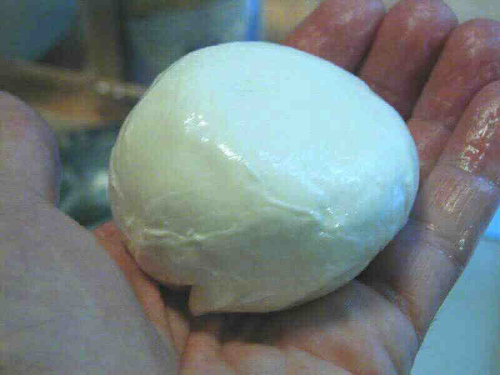
Press or cut the hot cheese into pieces (mozzato in Italian) and form into balls about the size of a lemon (size depends on how you wish to use it. In Italy, they are most often about 2 inches in diameter). Stretch and fold over and over on itself to form thin layers. The balls should be glossy and smooth on the outside. Here is a finished ball of mozarrella.
Plunge into cold salted water (1 Tbl salt/quart) and store in the refrigerator a few hours to firm up. It may be stored for several days in this brine, but is best when it is freshest.
Ideally, when freshest mozzarella is cut, the thin onion-like layers of stretched should be visible, surface smooth and tight and a texture between rubbery and soft. The onion layers disappear after less than a day after making.
I believe that the problems I have had making mozzarella are primarily due to insufficient acidity in the curd. The result is a tough, rubbery mozzarella.
You may know that the classic and simple Neapolitan service of this delicious cheese is to slice it, and serve on slices of fully vine-ripened tomato slices, drizzled with olive oil and then balsamic vinegar, and finally sprinkled with fresh basil, salt and freshly ground pepper.
Blend yogurt and buttermilk together, add a small amount of milk, whisk into 32°C milk.
Stir in dissolved rennet thoroughly, cover, let sit in warm spot until gelled (clean break), about 45 minutes.
Cut curd with clean knife into 1/2 inch cubes. (See my protocol for basic cheese, steps 9 and 10 for precise instructions on cutting the curd).
Re-warm to 32°C with stirring, cutting larger chunks of curd into smaller pieces with table knife. Let sit 15 minutes.
Pour off whey (save for ricotta), add curd to 2 qts cold water to rinse, drain in colander.
CRITICAL STEP FOR PROPER SPINNING OF THE CURD: Let sit at room temperature to develop acidity. The last two times I have made it, I let it sit overnight, and it was ripe for spinning. The final pH should be 5.3. You can monitor the acidification using pH paper with a range of about 4.8 to 6.2. (It might be ready in only 5-10 hours, but with goats milk, overnight has worked best for me. You can tell that proper acidity is achieved when the curd, upon heating, spins.
Checking for proper acidity using the spinning technique:
a) Heat 2 c water to 85°C. b) Drop several chunks of curd in, stir gently with a fork. c) Test for acidity by pulling and folding the hot curd. If it softens and draws into strings (spins), and appears glossy on the surface, it is ready. If it breaks when you pull it, let sit several more hours until it does.
Once the curd will spin, break or cut up the curd into pieces about 1/2 inch diameter. Place cut curd back in shallow glass baking pan.
Heat 1/2 gallon water to 85°C. Pour heated water over the curd, and stir with a slotted spoon. The temperature of the water should drop no lower than 57°C, but should not go above 60°C. As the curd warms, it should become more elastic, and finally spin.
Press or cut the hot cheese into pieces (mozzato in Italian) and form into balls about the size of a lemon (size depends on how you wish to use it. In Italy, they are most often about 2 inches in diameter). Stretch and fold over and over on itself to form thin layers. The balls should be glossy and smooth on the outside. Here is a finished ball of mozarrella.
Plunge into cold salted water (1 Tbl salt/quart) and store in the refrigerator a few hours to firm up. It may be stored for several days in this brine, but is best when it is freshest.
Ideally, when freshest mozzarella is cut, the thin onion-like layers of stretched should be visible, surface smooth and tight and a texture between rubbery and soft. The onion layers disappear after less than a day after making.
I believe that the problems I have had making mozzarella are primarily due to insufficient acidity in the curd. The result is a tough, rubbery mozzarella.
You may know that the classic and simple Neapolitan service of this delicious cheese is to slice it, and serve on slices of fully vine-ripened tomato slices, drizzled with olive oil and then balsamic vinegar, and finally sprinkled with fresh basil, salt and freshly ground pepper.
Notes
Click to add notes...
Nutrition Facts (per serving)
Calories
g
Protein
g
Carbs
g
Fat
g
Fiber
g
Sugar
mg
Sodium
mg
Cholesterol