
Best in: Spring, Summer, Fall, Winter
Ingredients (scaled)
1 servings
Directions
I. INOCULATION (Day 1) a. In early evening, warm one gallon milk to 95 F slowly so it does not burn on bottom. b. Blend in 1/4th cup cultured buttermilk thoroughly with a whisk. Use fresh, active cultured buttermilk. Either purchased, or home cultured will work if it is active. c. Let sit 15 minutes to allow the bacteria to wake up.
II. COAGULATION a. Meanwhile, dissolve 1/2 tablet rennet in 1/4th cup cool water. It will be slightly cloudy, but no chunks on the bottom. b. Stir dissolved rennet into inoculated milk, whisk to mix thoroughly, cover, place in a warm, protected spot. c. Let sit undisturbed in a warm place for approximately 2-3 hours until it displays a clean break. If you disturb the milk during this time, you will have problems getting a clean break .
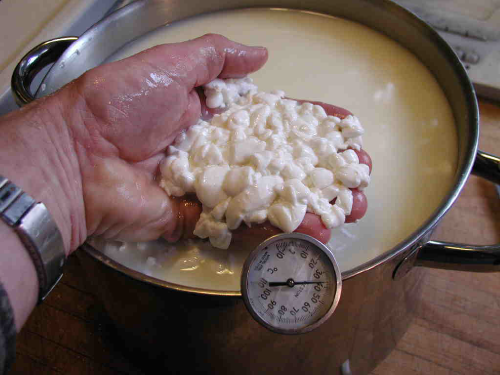
III. CUTTING THE CURD a. After two hours, test for a clean break. Do not proceed to the next step until you DO achieve a clean break. b. Once a clean break is achieved, cut the curd into 1/2 inch cubes. (see basic cheese page steps 9 through 11 for technique). c. Stir up cut curds gently with a clean hand, cutting pieces larger than 1/2 inch cubes into smaller pieces. Let sit 15 minutes with occasional stirring. d. Pour off whey which has come to the surface (about a quart, save for ricotta if you like). e. Warm curds to 97 F with gently constant hand stirring. It should never feel hot at the bottom
IV. ACIDIFICATION a. Replace the cover and let the 97 F curds (and remaining whey) sit in warm place overnight (at least 8 hours). Here I have place it on top of a slightly warm wood stove, buffering the temperature with a larger pot of water. I have also had success by placing the curds in front of the refrigerator fan which blows warm air. Be sure the pot is securely covered.
V. MELTING (Day 2) a. Next morning, test for proper 'spin' of the acidified curd by dropping a few pieces of curd into 185 F water, stirring with a fork, and testing to see if it 'spins:' pulls like taffy. If it breaks apart when you pull it, let the curds sit additional hours until it does 'spin.' b. Once it spins, warm 1/2 gallon fresh water to 185 F. c. Meanwhile, pour off all the remaining whey from the curds and whey. (Save a pint of the whey for acidified brine (below, step VI.d.) and the rest for ricotta ). d. Break the curd mass into small pieces with your hands. (I have put it in a colander to ease draining. If you carefully perform the previous step, a colander is unnecessary.) e. With the broken up curds in the 1 1/2 gallon pot, pour the 1/2 gallon 185 F water over the curd pieces, stir with a slotted spoon until it forms a gummy mass. The temperature will drop to about 130-140 F.
VI. MOLDING AND BRINING a. Stir the curd in the hot water so that it comes together to form a gummy mass, pressing and folding with the spoon. b. Pinch off lemon sized pieces of the hot dough-like cheese, fold over and over on itself to form a smooth ball. Briefly replace in the 185 F water to soften, and mold to even out the smoothness of the ball. c. Drop smoothed ball into iced cold water to firm up the ball. Repeat the shaping of balls for the rest of the curd. You should get about four 4-5 ounce balls from a gallon of milk. d. Prepare brine: in a 1/2 gallon jar, dissolve 1/4 cup salt in 1 pint fresh cool water plus 1 pint of whey (from step V.c.) e. Drop the cooled mozzarella balls in the brine, cover and refrigerate. f. After 12-24 hours, remove from brine, place balls in zip lock bags until used. (Do not leave too long in the brine, or the surface will soften.) g. Use within several days or a week of preparation. Fresher is better.
II. COAGULATION a. Meanwhile, dissolve 1/2 tablet rennet in 1/4th cup cool water. It will be slightly cloudy, but no chunks on the bottom. b. Stir dissolved rennet into inoculated milk, whisk to mix thoroughly, cover, place in a warm, protected spot. c. Let sit undisturbed in a warm place for approximately 2-3 hours until it displays a clean break. If you disturb the milk during this time, you will have problems getting a clean break .
III. CUTTING THE CURD a. After two hours, test for a clean break. Do not proceed to the next step until you DO achieve a clean break. b. Once a clean break is achieved, cut the curd into 1/2 inch cubes. (see basic cheese page steps 9 through 11 for technique). c. Stir up cut curds gently with a clean hand, cutting pieces larger than 1/2 inch cubes into smaller pieces. Let sit 15 minutes with occasional stirring. d. Pour off whey which has come to the surface (about a quart, save for ricotta if you like). e. Warm curds to 97 F with gently constant hand stirring. It should never feel hot at the bottom
IV. ACIDIFICATION a. Replace the cover and let the 97 F curds (and remaining whey) sit in warm place overnight (at least 8 hours). Here I have place it on top of a slightly warm wood stove, buffering the temperature with a larger pot of water. I have also had success by placing the curds in front of the refrigerator fan which blows warm air. Be sure the pot is securely covered.
V. MELTING (Day 2) a. Next morning, test for proper 'spin' of the acidified curd by dropping a few pieces of curd into 185 F water, stirring with a fork, and testing to see if it 'spins:' pulls like taffy. If it breaks apart when you pull it, let the curds sit additional hours until it does 'spin.' b. Once it spins, warm 1/2 gallon fresh water to 185 F. c. Meanwhile, pour off all the remaining whey from the curds and whey. (Save a pint of the whey for acidified brine (below, step VI.d.) and the rest for ricotta ). d. Break the curd mass into small pieces with your hands. (I have put it in a colander to ease draining. If you carefully perform the previous step, a colander is unnecessary.) e. With the broken up curds in the 1 1/2 gallon pot, pour the 1/2 gallon 185 F water over the curd pieces, stir with a slotted spoon until it forms a gummy mass. The temperature will drop to about 130-140 F.
VI. MOLDING AND BRINING a. Stir the curd in the hot water so that it comes together to form a gummy mass, pressing and folding with the spoon. b. Pinch off lemon sized pieces of the hot dough-like cheese, fold over and over on itself to form a smooth ball. Briefly replace in the 185 F water to soften, and mold to even out the smoothness of the ball. c. Drop smoothed ball into iced cold water to firm up the ball. Repeat the shaping of balls for the rest of the curd. You should get about four 4-5 ounce balls from a gallon of milk. d. Prepare brine: in a 1/2 gallon jar, dissolve 1/4 cup salt in 1 pint fresh cool water plus 1 pint of whey (from step V.c.) e. Drop the cooled mozzarella balls in the brine, cover and refrigerate. f. After 12-24 hours, remove from brine, place balls in zip lock bags until used. (Do not leave too long in the brine, or the surface will soften.) g. Use within several days or a week of preparation. Fresher is better.
Notes
Click to add notes...
Nutrition Facts (per serving)
Calories
g
Protein
g
Carbs
g
Fat
g
Fiber
g
Sugar
mg
Sodium
mg
Cholesterol