
Ingredients (scaled)
24 servings
Directions
PREPARE WRAPPERS: Night before: Sort out corn husks, clean dirt if any. Soak in water over night. Pull out a few unusable husks and tear into strips for ties. Tie two together to make longer and put back in water. Alternatively, cover husks with boiling water and let sit for an hour or two.
PREPARE MASA: In the morning mix on medium speed the masa, broth (keep a little aside), baking powder, pepper powder, garlic powder, salt and pepper until fluffy (about 4 minutes). Should be like soft peanut butter. Add remaining broth if necessary. Transfer to a bowl. Put shortening in mixer bowl (no need to wash) and beat until fluffy. While mixer is on, take golf ball sized hunks of masa and throw in one at a time until each is fluffy like every 15 seconds. Should be mixed about 5 minutes. Test by dropping a 1/2-teaspoon dollop of the batter in a cup of cold water (if it floats you can be sure the tamales will be tender and light).
ASSEMBLE TAMALES: Spread masa on husk with masa spreader. Put 2 tablespoons or so on masa. Wrap, fold up tail and tie. With steamer basked on its side, pile in the tamales. Fill gap with loosely crumpled foil. Steam for 1-1/2 hours or until masa pulls away from husk easily.
PREPARE FILLING: Filling should not be sopping wet. Try thickening with corn starch or potato flour or masa next time.
CHICKEN: For chicken filling use two 8-oz tubs of my Chicken Just Chicken, one onion and one can ortega chiles and 1/2 teaspoon garlic. Use concentrated chicken stock in the masa and in the chicken filling.
CHEESE: Use Jack cheese and tomatillo sauce
BEEF:
PORK:
Filling and cooking tamales Use one corn husk per tamale. Lay flat on table. The corn husk is roughly rectangle shaped. Spread 1/2 cup of Masa mixture on entire upward facing corn husk, leaving a 1 inch (2.5cm) gap along the long edge and narrow end of the corn husk. Spread 1 tablespoon of meat mixture, in a narrow band in the middle, down the length of the masa spread corn husk.
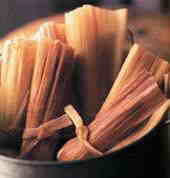
Roll/fold the husk along the wide edge, touching the edges of the masa together, with the meat mixture ending up in the middle of the masa. The part of the husk with the 1 inch gap with no masa should be rolled around the outside of the husk. Fold about 1 inch of end of rolled husk, upward along the body of the husk. (The narrow end with 1 inch masa gap). You should end up with something resembling a cornucopia, with one end folded over and one end open.
Stand all of the rolled tamales on end in a steaming collinder with the open end of the tamale facing upward. Steam the tamales over boiling water for 2 hours. Place a lid over the steaming collinder. Keep the tamales above the boiling water, dont allow them to stand in it. At the end of the cooking period, open one tamale and make sure the masa is cooked and not doughy. Allow tamales to rest 30 minutes after cooking, before serving. This will help to keep the masa from sticking to the corn husk.
One by one form the tamales: lay one of the good cornhusks in front of you, lightly dry it, then spread about a scant 1/4 cup of the batter into a 4-inch square, leaving at least a 1 1/2-inch border on the pointy end of the husk, a 3/4-inch border along the other sides. Spoon a good 2 tablespoons of the filling down the center of the batter. Pick up the two long sides of the husk and bring them together (this will cause the batter to roll around the filling, enclosing it). Roll the flaps of the husk in the same direction around the tamal. (If the husk is so small that the tamal doesnt seem very well wrapped, roll it in another husk.) Fold up the empty, pointy 1 1/2-inch section to close off the bottom, then secure it by loosely tying one of the strips of husk around the tamal and folded flap. Stand the tamal on the folded end in the steamer (the top of the tamal will be open).
Continue spreading, filling, rolling and folding until all the tamales are made (you may have a little filling left, which is great in scrambled eggs or soft tacos). Fill in any gaps in the steamer with loosely wadded foil, to keep the tamales from sliding down as they steam. Lay any unused husks over the tamales, then bring a couple of inches of water in the steamer to a boil. Cover the pot tightly and steam over medium heat for 1 to 1 1/4 hours (ones made from reconstituted masa will take a little longer than those made from fresh); make sure that the water stays at a good steady boil and never runs out--otherwise your tamales won't be as light. If the water runs low, pour a little boiling water into the steamer, being careful not to pour it onto the tamales. The tamales are done when the husk peels away easily. Let them firm up a few minutes in the steamer, off the heat, before serving
Hints I found: A rolling boil is much better than a simmer. Look up the tamale coin trick, especially if your steamer leaks steam, and you are steaming for 1.5 hours. If you miss the chance to add water, and the pot goes dry, all your work will be ruined. The masa will soak up burnt pan scent, and be ruined. Better safe than sorry. If you place a coin into the water while you are steaming, if the coin ever stops rattling, thats your signal to add water. A tad off topic, but the dough in that picture looks like its going to steam up into a dense brick. In viewing the recipe, I see someone has already commented on the lack of leavening. One more way to get tender, melt in your mouth dough (instead of dry dense brick dough like pictured in your photo) is to cream the fat much longer than the recipe used here calls for. Again, an old trick is the cold water test. If a tsp of your final dough floats in cold water, then your tamales will be tender and the dough will melt in your mouth. if it sinks, you have more mixing to do. As a rule of thumb, its MUCH easier to first whip/cream the fat until it triples in size before incorporating it into the other ingredients for the masa. Maybe its a preference thing, but I never understood why so many ppl make tamales with that dense, dry, masa. It doesnt make sense to me
PREPARE MASA: In the morning mix on medium speed the masa, broth (keep a little aside), baking powder, pepper powder, garlic powder, salt and pepper until fluffy (about 4 minutes). Should be like soft peanut butter. Add remaining broth if necessary. Transfer to a bowl. Put shortening in mixer bowl (no need to wash) and beat until fluffy. While mixer is on, take golf ball sized hunks of masa and throw in one at a time until each is fluffy like every 15 seconds. Should be mixed about 5 minutes. Test by dropping a 1/2-teaspoon dollop of the batter in a cup of cold water (if it floats you can be sure the tamales will be tender and light).
ASSEMBLE TAMALES: Spread masa on husk with masa spreader. Put 2 tablespoons or so on masa. Wrap, fold up tail and tie. With steamer basked on its side, pile in the tamales. Fill gap with loosely crumpled foil. Steam for 1-1/2 hours or until masa pulls away from husk easily.
PREPARE FILLING: Filling should not be sopping wet. Try thickening with corn starch or potato flour or masa next time.
CHICKEN: For chicken filling use two 8-oz tubs of my Chicken Just Chicken, one onion and one can ortega chiles and 1/2 teaspoon garlic. Use concentrated chicken stock in the masa and in the chicken filling.
CHEESE: Use Jack cheese and tomatillo sauce
BEEF:
PORK:
Filling and cooking tamales Use one corn husk per tamale. Lay flat on table. The corn husk is roughly rectangle shaped. Spread 1/2 cup of Masa mixture on entire upward facing corn husk, leaving a 1 inch (2.5cm) gap along the long edge and narrow end of the corn husk. Spread 1 tablespoon of meat mixture, in a narrow band in the middle, down the length of the masa spread corn husk.
Roll/fold the husk along the wide edge, touching the edges of the masa together, with the meat mixture ending up in the middle of the masa. The part of the husk with the 1 inch gap with no masa should be rolled around the outside of the husk. Fold about 1 inch of end of rolled husk, upward along the body of the husk. (The narrow end with 1 inch masa gap). You should end up with something resembling a cornucopia, with one end folded over and one end open.
Stand all of the rolled tamales on end in a steaming collinder with the open end of the tamale facing upward. Steam the tamales over boiling water for 2 hours. Place a lid over the steaming collinder. Keep the tamales above the boiling water, dont allow them to stand in it. At the end of the cooking period, open one tamale and make sure the masa is cooked and not doughy. Allow tamales to rest 30 minutes after cooking, before serving. This will help to keep the masa from sticking to the corn husk.
One by one form the tamales: lay one of the good cornhusks in front of you, lightly dry it, then spread about a scant 1/4 cup of the batter into a 4-inch square, leaving at least a 1 1/2-inch border on the pointy end of the husk, a 3/4-inch border along the other sides. Spoon a good 2 tablespoons of the filling down the center of the batter. Pick up the two long sides of the husk and bring them together (this will cause the batter to roll around the filling, enclosing it). Roll the flaps of the husk in the same direction around the tamal. (If the husk is so small that the tamal doesnt seem very well wrapped, roll it in another husk.) Fold up the empty, pointy 1 1/2-inch section to close off the bottom, then secure it by loosely tying one of the strips of husk around the tamal and folded flap. Stand the tamal on the folded end in the steamer (the top of the tamal will be open).
Continue spreading, filling, rolling and folding until all the tamales are made (you may have a little filling left, which is great in scrambled eggs or soft tacos). Fill in any gaps in the steamer with loosely wadded foil, to keep the tamales from sliding down as they steam. Lay any unused husks over the tamales, then bring a couple of inches of water in the steamer to a boil. Cover the pot tightly and steam over medium heat for 1 to 1 1/4 hours (ones made from reconstituted masa will take a little longer than those made from fresh); make sure that the water stays at a good steady boil and never runs out--otherwise your tamales won't be as light. If the water runs low, pour a little boiling water into the steamer, being careful not to pour it onto the tamales. The tamales are done when the husk peels away easily. Let them firm up a few minutes in the steamer, off the heat, before serving
Hints I found: A rolling boil is much better than a simmer. Look up the tamale coin trick, especially if your steamer leaks steam, and you are steaming for 1.5 hours. If you miss the chance to add water, and the pot goes dry, all your work will be ruined. The masa will soak up burnt pan scent, and be ruined. Better safe than sorry. If you place a coin into the water while you are steaming, if the coin ever stops rattling, thats your signal to add water. A tad off topic, but the dough in that picture looks like its going to steam up into a dense brick. In viewing the recipe, I see someone has already commented on the lack of leavening. One more way to get tender, melt in your mouth dough (instead of dry dense brick dough like pictured in your photo) is to cream the fat much longer than the recipe used here calls for. Again, an old trick is the cold water test. If a tsp of your final dough floats in cold water, then your tamales will be tender and the dough will melt in your mouth. if it sinks, you have more mixing to do. As a rule of thumb, its MUCH easier to first whip/cream the fat until it triples in size before incorporating it into the other ingredients for the masa. Maybe its a preference thing, but I never understood why so many ppl make tamales with that dense, dry, masa. It doesnt make sense to me
Notes
Click to add notes...
Nutrition Facts (per serving)
Calories
g
Protein
g
Carbs
g
Fat
g
Fiber
g
Sugar
mg
Sodium
mg
Cholesterol