
Best in: Spring, Summer, Fall, Winter
Ingredients (scaled)
12 servings
Directions
Preheat the oven to 450°F. Line a large baking sheet with parchment paper.
In the bowl of a food processor, combine the flour, sugar, baking powder, baking soda and salt. Add the butter or the shortening and pulse the food processor several times to cut the fat into the flour until the mixture resembles coarse meal. You can also do this by hand with a pastry blender. The faster you do this the better, you want the fat to remain cold. Stir in the buttermilk until just combined. DO NOT overmix, the dough will be slightly sticky.
Turn the dough out onto a floured surface and dust the dough with flour. Gently pat the dough out until its a 1/2-inch in thickness. Use a 2-inch round biscuit cutter to push straight down through the dough to cut out circles, try not to twist the cutter. Place the biscuits on the baking sheet, spacing 2-inches apart. Reform the scrap dough into 1/2-inch thickness, being sure to work with it as little as possible, before cutting out more circles. You should get 10 to 12 biscuits.
Bake the biscuits until golden brown, about 12 to 15 minutes.
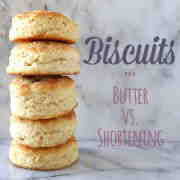
To experiment with butter versus shortening, I used the following standard biscuit recipe, which is my go-to. I used the same techniques, ingredients (except the fat of course), baking times and temperatures to ensure consistency between the two batches.
The all-butter dough was slightly less cohesive than the all-shortening dough, and I attribute this to the fact that the butter's texture is firmer than shortening. Even when both fats were chilled in the same freezer for the same length of time, the butter was significantly more solid which made it easier to retain chunks of butter while mixing the dough. The cold chunks of butter are important because as they melt into the biscuit while baking they create tiny pockets of steam that puffs and lifts the dough. These pockets turn into that beautiful light and flaky texture we crave with biscuits. The steam comes from butter's water content, which is usually about 15 to 20 percent. Those chunks of butter, while as glorious as they become while baking, do make the dough a little loose and slightly difficult to work with. Not to mention butter's low melting point makes it more difficult to work with as it needs to be cautiously kept cold.
The shortening dough, on the other hand, came together much more easily. In fact, it came together almost too much. If you overwork biscuit dough you run the risk of getting tough and dense biscuits. With the shortening being so sticky itself, even when chilled, it made it hard to retain any sort of looseness in the dough. Instead, it all came together in a slightly sticky, shaggy mass. This doesn't matter as much as it does with the all-butter dough, however. Where butter is only about 80 percent fat and the rest is milk and water, shortening is 100 percent fat. There is no steam created in shortening dough that lends the same light, airy flakiness as with butter dough. While the shortening dough was nicely cohesive, the stickiness made it difficult to roll out and shape. Any type of biscuit dough, or even pie dough which is very similar, is going to be more difficult to work with than a soft, smooth, and supple yeast dough. The pay off, however, is that it only takes about a half hour to make biscuits from start to finish!
So, what happened when the biscuits came out of the oven? Well, upon first glance the butter biscuits were significantly more browned with flatter tops. When bitten into, the butter biscuits were moist and slightly spongier than the shortening biscuits. The best part was the flavor and slightly more crunchy exterior texture contrasted by that ultra tender interior.
The shortening biscuits were much more pale, with slightly domed craggy tops. They also seemed a bit more irregular in height. The biscuits themselves were more crumbly when bitten into and lacked that characteristic butter flavor that simply cannot be replicated by anything artificial
So what's the final verdict? Butter is the winner here. The butter biscuits were moister with that wonderful butter taste and melt-in-your mouth texture. I'd be curious to test out substituting half or just two tablespoons of the butter with shortening to see if you get the best of both.
In the bowl of a food processor, combine the flour, sugar, baking powder, baking soda and salt. Add the butter or the shortening and pulse the food processor several times to cut the fat into the flour until the mixture resembles coarse meal. You can also do this by hand with a pastry blender. The faster you do this the better, you want the fat to remain cold. Stir in the buttermilk until just combined. DO NOT overmix, the dough will be slightly sticky.
Turn the dough out onto a floured surface and dust the dough with flour. Gently pat the dough out until its a 1/2-inch in thickness. Use a 2-inch round biscuit cutter to push straight down through the dough to cut out circles, try not to twist the cutter. Place the biscuits on the baking sheet, spacing 2-inches apart. Reform the scrap dough into 1/2-inch thickness, being sure to work with it as little as possible, before cutting out more circles. You should get 10 to 12 biscuits.
Bake the biscuits until golden brown, about 12 to 15 minutes.
To experiment with butter versus shortening, I used the following standard biscuit recipe, which is my go-to. I used the same techniques, ingredients (except the fat of course), baking times and temperatures to ensure consistency between the two batches.
The all-butter dough was slightly less cohesive than the all-shortening dough, and I attribute this to the fact that the butter's texture is firmer than shortening. Even when both fats were chilled in the same freezer for the same length of time, the butter was significantly more solid which made it easier to retain chunks of butter while mixing the dough. The cold chunks of butter are important because as they melt into the biscuit while baking they create tiny pockets of steam that puffs and lifts the dough. These pockets turn into that beautiful light and flaky texture we crave with biscuits. The steam comes from butter's water content, which is usually about 15 to 20 percent. Those chunks of butter, while as glorious as they become while baking, do make the dough a little loose and slightly difficult to work with. Not to mention butter's low melting point makes it more difficult to work with as it needs to be cautiously kept cold.
The shortening dough, on the other hand, came together much more easily. In fact, it came together almost too much. If you overwork biscuit dough you run the risk of getting tough and dense biscuits. With the shortening being so sticky itself, even when chilled, it made it hard to retain any sort of looseness in the dough. Instead, it all came together in a slightly sticky, shaggy mass. This doesn't matter as much as it does with the all-butter dough, however. Where butter is only about 80 percent fat and the rest is milk and water, shortening is 100 percent fat. There is no steam created in shortening dough that lends the same light, airy flakiness as with butter dough. While the shortening dough was nicely cohesive, the stickiness made it difficult to roll out and shape. Any type of biscuit dough, or even pie dough which is very similar, is going to be more difficult to work with than a soft, smooth, and supple yeast dough. The pay off, however, is that it only takes about a half hour to make biscuits from start to finish!
So, what happened when the biscuits came out of the oven? Well, upon first glance the butter biscuits were significantly more browned with flatter tops. When bitten into, the butter biscuits were moist and slightly spongier than the shortening biscuits. The best part was the flavor and slightly more crunchy exterior texture contrasted by that ultra tender interior.
The shortening biscuits were much more pale, with slightly domed craggy tops. They also seemed a bit more irregular in height. The biscuits themselves were more crumbly when bitten into and lacked that characteristic butter flavor that simply cannot be replicated by anything artificial
So what's the final verdict? Butter is the winner here. The butter biscuits were moister with that wonderful butter taste and melt-in-your mouth texture. I'd be curious to test out substituting half or just two tablespoons of the butter with shortening to see if you get the best of both.
Notes
Click to add notes...
Nutrition Facts (per serving)
Calories
g
Protein
g
Carbs
g
Fat
g
Fiber
g
Sugar
mg
Sodium
mg
Cholesterol