
Best in: Spring, Summer, Fall, Winter
Ingredients (scaled)
1 servings
Directions
In the bowl of a food processor, pulse the flour, salt, and sugar until combined. Add the butter, and pulse until the mixture resembles coarse meal, with larger chunks of butter remaining. Drizzle 2 tablespoons of ice water over the mixture and pulse until it just comes together without being wet, sticky, or crumbly. Do not over mix. If the dough doesnt hold together when pinched between your fingers, add another tablespoon of water and pulse.
Place the dough on a large sheet of plastic wrap. Shape the dough into a disk, wrap well in the plastic, and chill in the fridge until firm, at least 1 hour or up to 3 days. Make ahead and freeze, well wrapped in plastic, for up to 2 months. Defrost in the fridge overnight. The dough is now ready to be rolled out and baked.
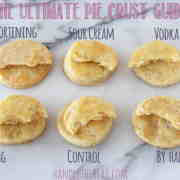
By Hand: Used the same exact ingredients but made the dough by hand, not in the food processor. I used a pastry blender to cut the butter into the flour mixture until it resembled coarse meal then gently stirred in ice cold water until the dough came together. More time-consuming and messy. The dough was more difficult to bring together into a disk because the chunks of butter were so irregular. However, those chunks of butter produced the flakiest results of all experiments. If you don't have a food processor or if you want the flakiest possible crust, this is definitely the method to use
Shortening: To determine differences between butter versus shortening I substituted all of the butter with cubed vegetable shortening. Dough was very easy to work with since shortening has a higher melting temp than butter. But also meant soft douigh was easily overworked, resulting in a crumbly instead of a flakey dough. This doesn't require as much chilling time and is soft and malleable. But this dough ended up being flat, tender, and fairly crumbly. The texture was reminiscent of shortbread and it was completely lacking in flavor. Like store-bought dough. Using a ratio of shortening and butter would produce better results, or mixing the shortening dough by hand instead of using the food processor to avoid over mixing.
Vodka: Kitchen scientists claim that by substituting a portion of the water with vodka, you prohibit gluten development making a tender, flaky crust. I added 2 tablespoons of cold vodka and reduced the water to 2 tablespoons. The texture was surprisingly crumbly but still easy to work. Baked up flakey and very tender. Didn't find the difference to be revolutionary. Id probably skip the vodka trick.
Sour Cream: Sour cream acts as a tenderizer in baked goods and I was curious to see if it would significantly affect the texture of pie crust. I added 2 tablespoons of sour cream to the control recipe along with the butter, keeping everything else the same. The dough itself was very soft and slightly sticky, but easy enough to work with. My circles of sour cream pie crust puffed up to a surprising height. The texture was ultra light, puffy, and flaky, almost like puff pastry. The flavor was also fantastic. Beyond the classic control and by hand recipes, this was my favorite pie crust
Egg: Many recipes for tart dough call for an egg. I wanted to know how the extra fat and liquid would affect the pie crust, so I added a whole beaten egg along with the water to the control recipe, keeping everything else the same. The dough came together in a more cohesive ball, which was not surprising since egg acts as a binding agent. The baked crust was rich and firm but tender. The flaky layers seemed heavier than the by hand crust and overall this bordered on being slightly greasy.
Place the dough on a large sheet of plastic wrap. Shape the dough into a disk, wrap well in the plastic, and chill in the fridge until firm, at least 1 hour or up to 3 days. Make ahead and freeze, well wrapped in plastic, for up to 2 months. Defrost in the fridge overnight. The dough is now ready to be rolled out and baked.
By Hand: Used the same exact ingredients but made the dough by hand, not in the food processor. I used a pastry blender to cut the butter into the flour mixture until it resembled coarse meal then gently stirred in ice cold water until the dough came together. More time-consuming and messy. The dough was more difficult to bring together into a disk because the chunks of butter were so irregular. However, those chunks of butter produced the flakiest results of all experiments. If you don't have a food processor or if you want the flakiest possible crust, this is definitely the method to use
Shortening: To determine differences between butter versus shortening I substituted all of the butter with cubed vegetable shortening. Dough was very easy to work with since shortening has a higher melting temp than butter. But also meant soft douigh was easily overworked, resulting in a crumbly instead of a flakey dough. This doesn't require as much chilling time and is soft and malleable. But this dough ended up being flat, tender, and fairly crumbly. The texture was reminiscent of shortbread and it was completely lacking in flavor. Like store-bought dough. Using a ratio of shortening and butter would produce better results, or mixing the shortening dough by hand instead of using the food processor to avoid over mixing.
Vodka: Kitchen scientists claim that by substituting a portion of the water with vodka, you prohibit gluten development making a tender, flaky crust. I added 2 tablespoons of cold vodka and reduced the water to 2 tablespoons. The texture was surprisingly crumbly but still easy to work. Baked up flakey and very tender. Didn't find the difference to be revolutionary. Id probably skip the vodka trick.
Sour Cream: Sour cream acts as a tenderizer in baked goods and I was curious to see if it would significantly affect the texture of pie crust. I added 2 tablespoons of sour cream to the control recipe along with the butter, keeping everything else the same. The dough itself was very soft and slightly sticky, but easy enough to work with. My circles of sour cream pie crust puffed up to a surprising height. The texture was ultra light, puffy, and flaky, almost like puff pastry. The flavor was also fantastic. Beyond the classic control and by hand recipes, this was my favorite pie crust
Egg: Many recipes for tart dough call for an egg. I wanted to know how the extra fat and liquid would affect the pie crust, so I added a whole beaten egg along with the water to the control recipe, keeping everything else the same. The dough came together in a more cohesive ball, which was not surprising since egg acts as a binding agent. The baked crust was rich and firm but tender. The flaky layers seemed heavier than the by hand crust and overall this bordered on being slightly greasy.
Notes
Click to add notes...
Nutrition Facts (per serving)
Calories
g
Protein
g
Carbs
g
Fat
g
Fiber
g
Sugar
mg
Sodium
mg
Cholesterol