
Best in: Spring, Summer, Fall, Winter
Ingredients (scaled)
8 servings
Directions
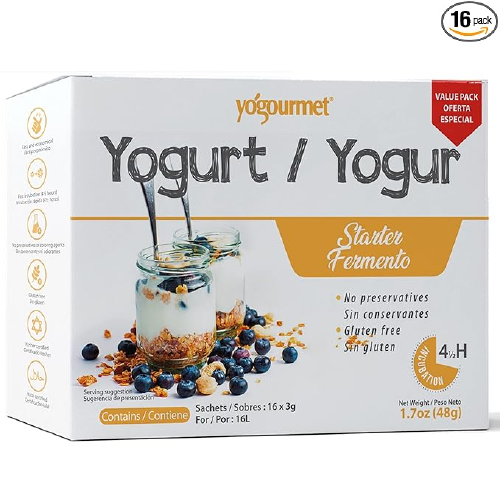
Heat milk in saucepan to 185F. Remove and cool to 112F to 115F so starter will not be destroyed. Should take around an hour. Skim off skin.
Meanwhile, prepare IP for incubation. Fill main pot with water with grate on bottom. Using Ultra setting (sous vide) set to 110F and time to 8 hours.
While IP is heating, put starter in one of the jars. Pour1/4 cup of the cooled milk into the jar and whisk it into the starter so no lumps remain. Put back into pot of milk and whisk well to distribute. Pour into pint jars, leaving about ?½ inch of headspace. Put lids on. Set jars in water in instant pot. Add or reduce water so it is just under lids.
When the 8 hours are up, the IP will beep. Remove lid. Yogurt should be soft to medium firm. Carefully remove jars and put in fridge until cold.
Effects of various incubation time: 7 Hours: Well-developed flavor, noticeable tang, Stable texture. Less likely to separate. For those who like mild-to-medium tartness 8 Hours: Moving into tart territory, Thicker and more concentrated.. Good balance of flavor/texture for most tastes
For a firmer yogurt Without excess starter, avoid graininess, over-tartness, whey separation, adjust the milk composition, culture choice, processing steps, or use natural thickeners. Below are several effective strategies. 1. Increase Milk Solids: Raising the proportion of non-fat milk solids yields a thicker, creamier body. Dissolve 1–2 tablespoons of non-fat dry milk per quart into the warmed milk before inoculation. 2. Different Culture: Some make more extracellular polysaccharides (EPS), which thickens the gel. Use EPS starter: Lactobacillus bulgaricus- Streptococcus thermophilus strains yield a firmer gel. Blend in a Greek-style culture: Commercial Greek-style yogurt starters are optimized for firmness. 3. Control Fermentation: Slowing acidification gives proteins more time to form a stable network. Ferment at a lower temperature (105–108°F) for longer (8–10 hours) rather than 110–115°F for 5–6 hours. Maintain a steady temperature: minimize fluctuations by preheating your incubator or using an insulated cooler. 4. Natural Thickeners: Innocuous thickeners can boost firmness without altering flavor. Gelatin: Dissolve1 tsp plain gelatin in a few Tbls cold water for 5 mins. Stir into warmed milk before inoculation. Pectin or agar-agar: agents per manufacturer guidelines—typically 0.5–1% of milk weight.
Meanwhile, prepare IP for incubation. Fill main pot with water with grate on bottom. Using Ultra setting (sous vide) set to 110F and time to 8 hours.
While IP is heating, put starter in one of the jars. Pour1/4 cup of the cooled milk into the jar and whisk it into the starter so no lumps remain. Put back into pot of milk and whisk well to distribute. Pour into pint jars, leaving about ?½ inch of headspace. Put lids on. Set jars in water in instant pot. Add or reduce water so it is just under lids.
When the 8 hours are up, the IP will beep. Remove lid. Yogurt should be soft to medium firm. Carefully remove jars and put in fridge until cold.
Effects of various incubation time: 7 Hours: Well-developed flavor, noticeable tang, Stable texture. Less likely to separate. For those who like mild-to-medium tartness 8 Hours: Moving into tart territory, Thicker and more concentrated.. Good balance of flavor/texture for most tastes
For a firmer yogurt Without excess starter, avoid graininess, over-tartness, whey separation, adjust the milk composition, culture choice, processing steps, or use natural thickeners. Below are several effective strategies. 1. Increase Milk Solids: Raising the proportion of non-fat milk solids yields a thicker, creamier body. Dissolve 1–2 tablespoons of non-fat dry milk per quart into the warmed milk before inoculation. 2. Different Culture: Some make more extracellular polysaccharides (EPS), which thickens the gel. Use EPS starter: Lactobacillus bulgaricus- Streptococcus thermophilus strains yield a firmer gel. Blend in a Greek-style culture: Commercial Greek-style yogurt starters are optimized for firmness. 3. Control Fermentation: Slowing acidification gives proteins more time to form a stable network. Ferment at a lower temperature (105–108°F) for longer (8–10 hours) rather than 110–115°F for 5–6 hours. Maintain a steady temperature: minimize fluctuations by preheating your incubator or using an insulated cooler. 4. Natural Thickeners: Innocuous thickeners can boost firmness without altering flavor. Gelatin: Dissolve1 tsp plain gelatin in a few Tbls cold water for 5 mins. Stir into warmed milk before inoculation. Pectin or agar-agar: agents per manufacturer guidelines—typically 0.5–1% of milk weight.
Notes
Click to add notes...
Nutrition Facts (per serving)
Calories
g
Protein
g
Carbs
g
Fat
g
Fiber
g
Sugar
mg
Sodium
mg
Cholesterol